Wesleyan's Navaratri Festival at 50

Wesleyan's Navaratri Festival at 50

Navaratri (literally “nine nights”) is a Hindu festival in honor of the supreme goddess in her varied personifications of divine feminine energy. It is a time of prayer, devotion, music, dancing, fasting, and celebration. Through the fierce warrior form represented by the goddess Durga, Navaratri symbolizes the victory of good over evil and the triumph of light over darkness.

Wesleyan University first celebrated Navaratri in 1965. It was initiated by Robert E. Brown, who was hired as Wesleyan’s first ethnomusicologist. Under his direction it continued for several years until Brown left for California Institute of the Arts. In 1976 Navaratri was revived by T. Viswanathan, and the festival is now celebrating its 50th consecutive year. 

Because of Viswanathan and his eminent place as an artist in the world of classical Indian music, he was able to draw many of the most revered musicians and dancers in India to Wesleyan’s Navaratri. Under Viswa’s direction it was an exciting time, filled with the energy and enthusiasm of faculty, graduate and undergraduate students, including residents from outside of and within the Middletown area. Since Viswa’s unexpected passing in 2002, the Navaratri festival has become a cherished staple of Wesleyan’s World Music program. It continues to embrace and celebrate the South Asian community while serving as an important source of cultural affirmation for a new generation of South Asian Americans.

-Jody Cormack Viswanathan

This online exhibit serves as a landing point to collect the various audiovisual and print materials hosted digitally by Wesleyan University Library related to the Navaratri Festival. The creation of this exhibit corresponds with the commemoration of the 50th anniversary of Navaratri festivities on campus from October 8-11, 2026 which included numerous events, performances, lectures, and physical exhibitions. While some archival materials were already digitally available prior to the 50th anniversary, numerous historically relevant objects were digitized in the lead up to the anniversary celebration. Some of these materials, as noted in the records, are not currently held by the Wesleyan University Library but collected and owned by members of the Wesleyan community.

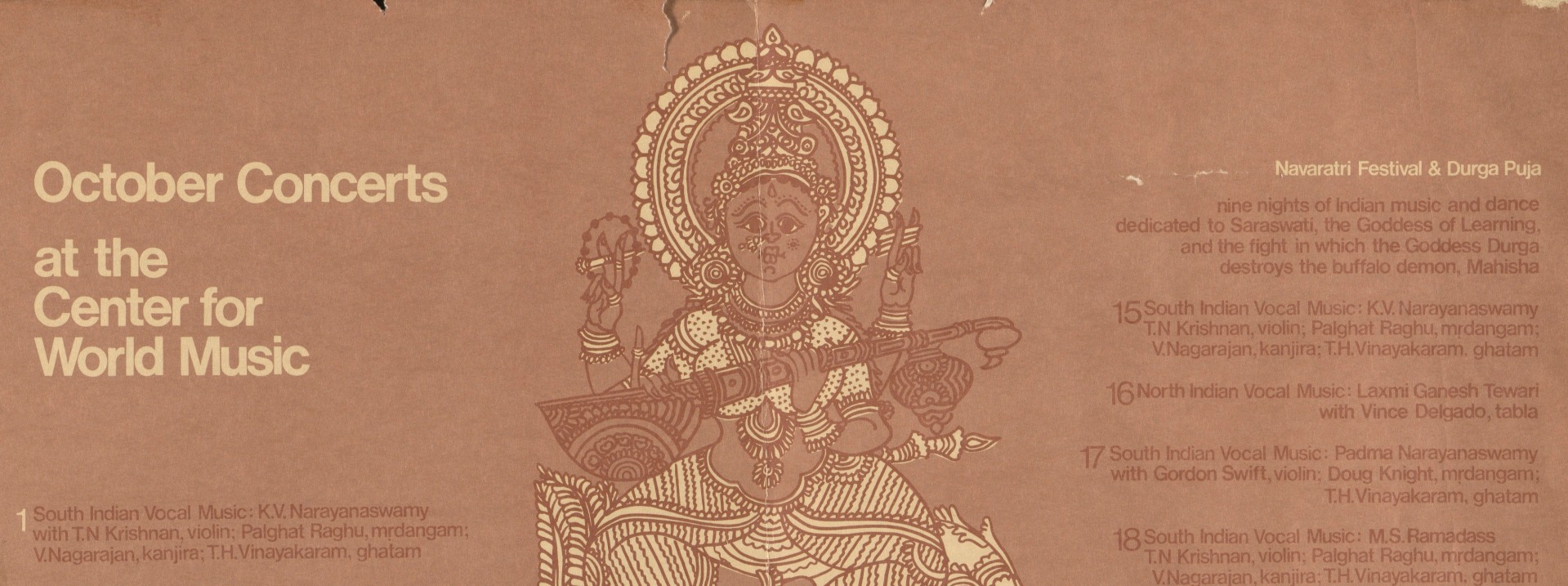
Several collections across campus hold graphically interesting ephemera made to advertise the Navaratri Festival on campus throughout the years. Drawing on and borrowing from Indian artistic traditions of relief sculpture and floral motifs; these eye-catching posters, programs, flyers, leaflets, and postcards were how many students and community members would have first heard about the event.